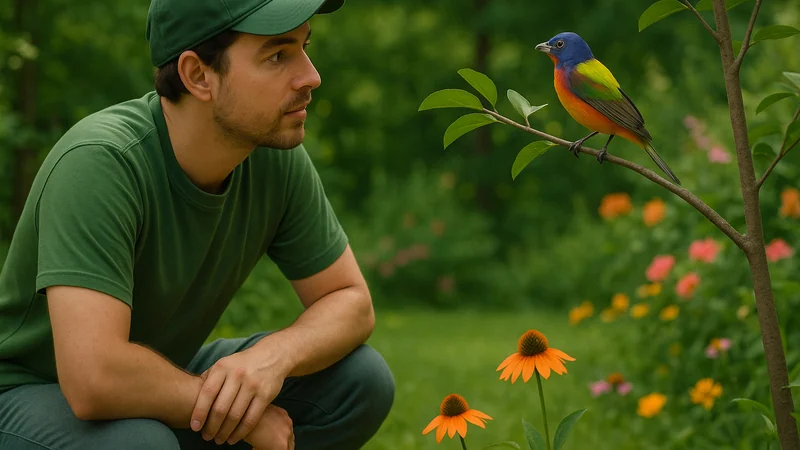
You find yourself on the porch, enjoying a cup of coffee, when something in the hedge catches your attention. You instinctively reach for your phone instead of a 400-page paperback. That instinct is spot on and highlights where much beginner advice falls short. Traditional bird identification methods were designed for people sitting still with binoculars and a book on their lap. However, backyard birdwatching isn't like that; it's often brief, unpredictable, and requires one-handed operation. The Bird Call Identifier app is designed for this reality on the iPhone, and this guide will show you how to use it without turning the moment into a study session.
The assumption to leave behind
Many people believe that memorizing a field guide is necessary before they can identify the birds outside their windows. Beginners often open a guide, see hundreds of species, and notice that many look similar to sparrows, which can lead to frustration and, ultimately, to giving up. The issue isn’t with the book itself; it lies in the assumption that bird identification is merely a knowledge test that must be passed before attempting to identify birds.
It is not. Identification is a matching problem, and matching requires only two things: a decent clue and a way to narrow the possibilities. The clue can be a two-second call, a silhouette on a wire, or a blurry photo through a screen door. The narrowing is what a book used to do slowly and what your phone can now do quickly. Once you accept that, the backyard becomes a place to practice rather than a quiz you keep failing.
Partial evidence is normal
The second assumption worth reconsidering is that the bird must remain still and pose. Most backyard identifications come from fragments.
- A wingbar you half-see as the bird dives into a shrub.
- A rattle from a rooftop you never locate.
- A flash of yellow in an oak that vanishes in a second.
Dedicated backyard bird enthusiasts focus on the small details and experiences of birdwatching rather than on idealized or overly polished images often seen on postcards.
What works instead
What is effective is the opposite of memorization. It is a small, repeatable loop you can run in the time it takes a bird to hop three branches. The loop has three steps: capture, compare, and confirm.
Capturing evidence of a bird means documenting whatever is available before it flies away. Sound recordings are often the easiest method, as birds can often be heard for several seconds, even when they are not visible. Photographs are useful when the bird is in sight but not close enough for detail. If you have no other options, a written description can also be helpful. Include details such as color, size relative to a robin, and the bird's behavior.
To compare means to evaluate that clue based on what is reasonable for your yard, considering the current time of year and your specific region. A phone can filter possibilities in ways a printed book cannot, because a book does not know your location or the current week.
Confirm means looking at the top suggestion and asking one honest question: does this match what I actually saw or heard? If the app suggests a Carolina Wren and you heard a loud, repeated teakettle-teakettle, you have a confirmation. If it suggests something you have never heard of and the photo looks nothing like your bird, you have a prompt to try again with a better clip. For a deeper look at how those short recordings sound in practice, the notes on backyard calls people look up most are a useful companion.
The method
A compact method to follow
On that porch, with the hedge still rustling, the entire process fits into a brief moment. Six small steps, in order: stop, pick, capture, match, cross-check, log.
- Stop moving. Birds react to motion before sound. Freeze first, then reach for the phone.
- Pick the strongest clue. If you hear it clearly, record. If you see it clearly, photograph. If both are weak, record anyway. Sound carries.
- Capture more than you think you need. Ten to fifteen seconds of audio is better than three. A burst of photos beats one careful shot.
- Run the match. Feed the clip or photo into your identifier and read the top result along with any close alternatives. Your general location and the season narrow the shortlist, since many yard birds are only around at certain times.
- Cross-check one field mark. Look up one distinguishing feature, such as tail length, breast streaking, or eye ring, and see if it holds. This step separates a guess from an ID.
- Log it. Save the sighting with the date and location. Your yard has patterns, and a running list is how you find them.
Six steps. No book or memorization needed. This method is small enough to use every time, which is how you truly learn the birds around you, through repetition rather than study.
A quick way to pick your clue
Step two is often where many people get stuck: how do you choose which clue to focus on when the bird is visible for only a brief moment? This quick decision-making guide eliminates uncertainty in that scenario, ensuring the rest of the process has a clear direction.
| Situation | Best clue to capture | Why |
|---|---|---|
| Bird is singing in dense leaves | Sound recording | You will not see it well enough to match on sight. |
| Bird is silent at the feeder | Photo or short video | Feeder birds hold still long enough for a shape and color read. |
| Flyover, no time to aim | Written note | Size, color, flight pattern, and direction beat a blurred photo. |
| Dawn chorus, many voices at once | Sound recording, longer clip | A longer clip gives more chances to isolate one caller. |
| Bird is calling from a rooftop | Short sound clip plus any photo you can grab | Two weak clues combined are stronger than one. |
When in doubt, record it. Sound rarely deceives you about which family you are hearing, even when your eyes cannot confirm which bird is making the sound.
When the rule has exceptions
The capture-compare-confirm loop is reliable, but backyards pose challenges. A few situations require minor adjustments to the method.
Mimics
Northern Mockingbirds, catbirds, and starlings are well known for mimicking other species' sounds. If a recording suggests a species that seems geographically unusual, or if the app frequently changes its identification during a long clip, it's wise to suspect a mimic. Mockingbirds typically repeat phrases several times before moving on, while catbirds tend to string sounds together with little repetition. Starlings often incorporate whistles and clicks that don't match the suggested species. In these cases, the identifier is matching a real sound; however, the bird producing it is not the one being imitated.
Juveniles and molting adults
Young birds and adults in molt often do not match the images in field guides. For example, consider the streaky, scruffy juvenile robin that appears under a feeder in late summer. It usually has speckled underparts and lacks the clean orange breast the field guide promised. If a photo identification seems inaccurate in such cases, try using a sound clip instead. Birdsong is usually more consistent than plumage.
Overlapping species
House Finch and Purple Finch, Downy Woodpecker and Hairy Woodpecker, Cooper's Hawk and Sharp-shinned Hawk. When the application hesitates between two closely related species, that is an honest choice, not a failure. Use one specific cross-check: look at the streaked versus clean undertail coverts for the finches, bill length relative to head width for the woodpeckers, and squared versus rounded tail tips for the hawks.
Loud environments
Traffic, lawnmowers, and air conditioners can drown out a call. If possible, move closer or wait a minute for the noise to pass. A clean five seconds beats a muddy thirty.
Rare visitors
Occasionally, a bird well outside its usual range shows up in a yard. If your app suggests something unlikely, do not dismiss it, but do not accept it uncritically either. A quick check against a regional field guide for backyard calls and sightings will tell you whether you have a true rarity or something worth another clip.
If you want to see how sound-based tools perform across different yards before you commit to one, the notes on how bird call identifier apps perform in the field are a useful next read.
In the app
How Bird Call Identifier supports the method
Bird Call Identifier is built for iPhone around exactly this loop. Available on the App Store, it lets you work from whatever clue you have: a recorded call, a photo, or a written description. That flexibility matters because backyard birds rarely cooperate by giving you one clean, obvious clue.
The capture, compare, and confirm loop maps to three things the app is designed to do:
- Capture. Tap record to let the app listen to a short backyard clip, snap a photo through the kitchen window, or type a quick description of color, size, and behavior.
- Compare. Read the top suggestion and its close alternatives together, and use the species pages to see photos and details alongside your own observation.
- Confirm and log. Turn a suggestion into a real identification by matching one field mark, then save the sighting so your yard list builds itself over the season.
Two honest limits are worth noting. No sound identifier, this one included, is right every time; dense choruses, mimics, and distant calls will produce their share of near-misses, which is why the cross-check step exists. And the app has not been independently benchmarked here against other identifiers, so treat the suggestions as strong starting points rather than final verdicts. It is a companion to your own attention, not a replacement for it.
Use the insight in practice
Tomorrow morning, before the coffee is cold, try this. Sit on the step for five minutes without opening any other app. When something calls, record ten seconds. When something lands, take one photo. Run each through the loop: capture, compare, confirm. Log what you find.
After a week, you'll notice something remarkable. You'll begin to recognize the two or three bird calls that greet you each morning without needing the app at all. You'll identify the chickadee's "fee-bee," the cardinal's "cheer-cheer-cheer," and the wren, which sounds larger than it is. The app shifts from being the primary resource to serving as a tiebreaker, the role a good tool should play.
So tomorrow, back on that same porch with the same cup of coffee, let the hedge rustle and see what happens when you run the loop instead of reaching for the book.