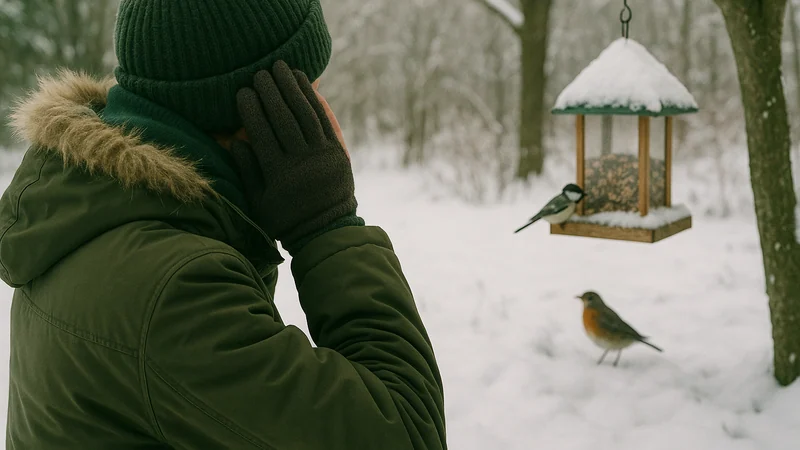
Winter birds are the easiest ones to learn by ear. Cold air carries sound farther, the chorus thins to a handful of species, and a January walk can feel quieter and clearer than a June morning. Learn the four or five voices that dominate a snowy backyard and you can name most of what you hear in a single season, and when a new call turns up you can record a short clip and let a phone-based bird call identifier settle it on the spot.
When leaves are down and the summer warblers are gone, the birds you hear are the ones that stayed. That short list is a gift for beginners. Instead of parsing thirty overlapping songs, you are usually choosing between a chickadee, a nuthatch, a woodpecker, a jay, a cardinal, and whatever finches showed up at the feeder that week.
The winter soundscape is smaller than you think
Most backyards across the northern and central United States and southern Canada host a stable cast of resident species from December through February, with the exact mix shifting by region. In the north you are more likely to hear black-capped chickadees; south of roughly the Ohio Valley you swap in Carolina chickadees, Carolina wrens, and red-bellied woodpeckers. White-breasted nuthatches, downy woodpeckers, blue jays, northern cardinals, and house finches or American goldfinches at the thistle are widespread. Along a wooded edge you might add a tufted titmouse or, in the right range, a Carolina wren belting out of proportion to its size.
The visitors are what make winter interesting. Dark-eyed juncos arrive in flocks and give a soft, musical trill from the hedge. White-throated sparrows whistle a slow, wistful phrase that sounds like a question. In irruption years, pine siskins, common redpolls, or evening grosbeaks might drop into a feeder for a week and then vanish. If your ear knows the residents cold, the visitors announce themselves by sounding new.
Why cold air changes what you hear
Winter listening is not just a shorter species list. The air itself behaves differently. Birders often notice that on still, cold mornings a call from a few hundred feet away can arrive sharper and more directional than it would on a humid August afternoon, a pattern acousticians link to temperature inversions that tend to bend sound back toward the ground. Fresh snow also tends to muffle high-frequency clutter, which is part of why a chickadee's whistle across a white yard can sound almost bell-like. And with no leaves to scatter it, sound travels in cleaner lines through the trees.
The practical effect: you can often identify birds farther away in winter than in summer, but you also have fewer visual cues to fall back on. Learning the sound is often the whole ID.
Six voices that dominate a winter yard
These are the sounds worth memorizing first, ordered roughly from the most common feeder regulars out to the noisier neighbors along the edge. Transcriptions follow the conventions used by the Cornell Lab of Ornithology's All About Birds and the Audubon field guide.
| Species | Sound to listen for | Where in the yard |
|---|---|---|
| Black-capped or Carolina chickadee | Clear two-note whistle written as fee-bee, plus the namesake chick-a-dee-dee-dee where more dees can signal more alarm | Mid-canopy, feeder, mixed flocks |
| White-breasted nuthatch | Nasal, honking yank yank yank | Head-down on a trunk or large branch |
| Downy woodpecker | Sharp, high pik and a descending whinny; short drumming rolls become more frequent in late winter | Small branches, suet feeder |
| Northern cardinal | Metallic chip call all winter, then a clear cheer cheer cheer or birdy birdy birdy song many birders start hearing on mild February mornings | Shrubs, hedges, feeder edge |
| Dark-eyed junco | Soft, dry trill from ground level and a light tick when the flock moves | Under the feeder, leaf litter |
| Blue jay | Loud, ringing jay jay, plus imitations of red-shouldered and sometimes red-tailed hawks that reportedly fool feeder-watchers | Canopy, feeder, treetops |
If you can reliably place those six, you have named a large share of the winter yard before you touch an app. Readers south of the chickadee overlap zone will hear Carolina chickadee where the transcription above says black-capped; the phrase pattern is the same, the tone is slightly higher and faster.
How to identify a winter call without a field guide open
Birding by ear is less about memorizing recordings and more about asking a short series of questions in the right order. In winter, with fewer species in play, the questions get easier.
- Is it a call or a song? Winter is mostly calls: short, functional notes used to stay in contact with a flock or scold a predator. Long, patterned songs are rare until late February.
- How long is the phrase? A single sharp note points to a chickadee, junco, cardinal, or woodpecker. A repeated phrase of three to six notes narrows toward jays, titmice, or an early cardinal warm-up.
- Where in the tree is it coming from? Trunk-level and moving downward is nuthatch territory. Mid-canopy chatter is often chickadees and titmice. Ground-level rustling with soft ticks is usually juncos or sparrows.
- Does it sound nasal, whistled, or metallic? Nasal points to nuthatches and jays. Pure whistles point to chickadees, titmice, and white-throated sparrows. Metallic chips point to cardinals.
- Is it alone, or is a flock answering? Winter mixed flocks travel together. If you hear one chickadee, listen for the nuthatch, downy, and kinglet that are almost certainly with it.
Run through those five questions and most winter calls resolve to two or three candidates. That is close enough to check with a recording.
Winter listening
Where a phone earns its place on a winter walk
The honest limit of birding by ear is that new voices sound like nothing you know until someone tells you what they are. A field guide with sonograms helps at home. In the moment, in the cold, with gloves on, it does not. That is the gap a pocket bird call identifier is built for.
Record, match, save
The workflow that fits winter listening is simple. Hear something you cannot place, pull the phone out, record a short clip of ten or twenty seconds through a bare hand rather than a mitten, and let the sound ID return a species match. Bird Call Identifier keeps that clip and lets you save the sighting, so a fox sparrow scratching in the leaf litter or a brown creeper spiraling up a trunk quietly builds into a winter list you can look back on next December.
Sound recognition apps are not infallible. Wind, distant traffic, and overlapping calls in a mixed flock can produce a wrong or uncertain match, especially with short clips. Treat a suggestion as a strong hint that you then confirm with a look, a second recording, or a check against the species range for your area. Used that way, the app is a teacher rather than an oracle, and winter is the ideal season to train on it because there are fewer confusable species competing for your attention.
When the bird is on a branch, not on tape
Bird Call Identifier also handles photo ID when you already grabbed a shot at the feeder window, which is useful for the finches and sparrows that all look vaguely brown until you learn the fieldmarks. You can see how both paths fit together in how it works.
A simple winter listening routine
You do not need a dawn chorus to make progress. A ten-minute routine, three or four mornings a week, does more for your ear than an occasional long walk.
- Step outside within an hour of sunrise, when winter birds are most active at feeders and along wooded edges.
- Stand still for the first two minutes and just listen. Do not reach for the phone yet. Let your ear adjust to the ambient level.
- Name every call you already know, out loud or in your head. This is the part that builds memory.
- Record the first sound you cannot place. Keep the clip short and steady, and try to face the bird rather than the wind.
- Check the suggestion, then look for the bird. Confirming the ID with your eyes locks the sound in far better than reading about it later.
- Log the sighting so next winter you can see which species show up in which weeks. Patterns emerge faster than you would expect.
Do that from December through February and you will finish the season knowing the resident cast by voice and recognizing at least a handful of winter visitors the moment they arrive.
What to listen for as winter turns
The last useful thing about winter birding by ear is that it gives you an early read on spring. Many birders report cardinals starting to practice full songs on the first mild mornings of February. Titmice add their peter-peter-peter whistle. House finches warble more insistently at the feeder. Woodpecker drumming shifts from occasional to territorial. None of these are migration events, but they are the first audible signs that the season is turning, and you will often notice them weeks before the calendar catches up. Those early clues make the first migration weeks easier to read; what to listen for as spring calls begin appearing is a useful next step.