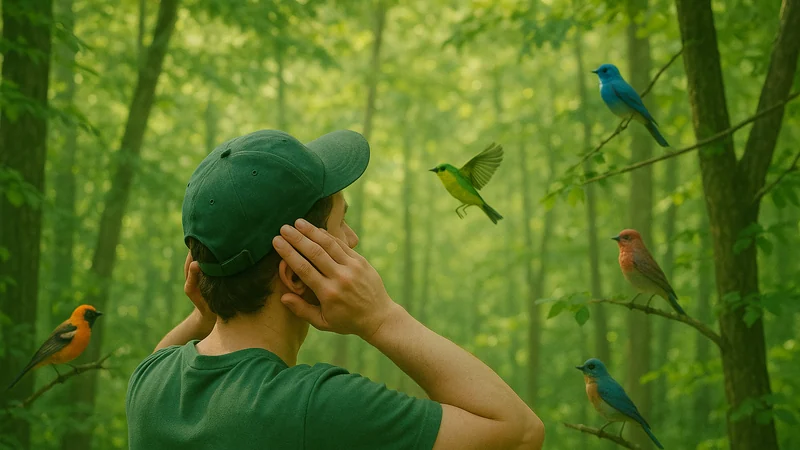
You heard something in the hedge. Maybe a rolling trill, maybe a sharp chip, maybe a long liquid warble that keeps changing. You opened your phone, tried a music recognizer, and got nothing. That is not a broken app. It is the wrong tool. Music apps fingerprint studio recordings against a catalog of released tracks. A yard bird has never signed a record deal.
For that yard bird you need an app trained on bird vocalizations. Bird Call Identifier is built for exactly that outdoor moment: record a few seconds of the call, and a bird-specific model returns a shortlist of likely species. The rest of this guide is a diagnostic walk-through for the times when the shortlist is not obvious, and how to turn the clue you have into a confident answer.
Separate the likely causes before you blame the app
When a sound ID attempt fails or feels wrong, the reason usually falls into one of a few buckets. The table below sorts them by their tell-tale sign so you can act without re-reading prose.
| Likely cause | Tell-tale sign | First thing to try |
|---|---|---|
| Wrong tool | A music recognizer returns nothing at all | Switch to an app trained on bird vocalizations |
| Signal too weak | The clip is mostly wind, traffic, or leaf rustle | Move closer and put noise sources behind your shoulder |
| Too many singers | A dawn chorus layers several voices at once | Wait for a solo phrase or move to isolate one bird |
| Unusual vocalization | Juvenile, alarm, mimic, or regional dialect | Note the context and try to catch a second, longer phrase |
| Range mismatch | The suggestion is a bird out of season or region | Check candidates two and three, cross-reference habitat |
Most frustrating outdoor moments come from the middle three. Once you know which one you are dealing with, the fix is usually small. Readers weighing sound-first tools head to head can compare how the same call is handled in our field notes on where sound ID actually holds up in the field.
Check the clue most people miss
Listen to the environment, not just the bird
Before you retry the recording, notice what is around you. Your phone microphone is omnidirectional and honest to a fault. It hears the highway two blocks over, the air conditioner behind you, and the wind moving through the hedge you are standing next to. All of that competes with a thin high whistle from a warbler high in the canopy.
The clue most beginners skip is the direction the bird is calling from relative to noise. If a highway is at your back and the bird is in front, walk ten steps so the noise source is off to one side. Turn your body so your shoulder blocks the wind reaching the phone. These are unglamorous adjustments and they change the recording more than any setting will.
Tell a call note from a song
The second missed clue is the length and structure of the vocalization itself. A short tsip repeated every four seconds is a call note, not a song. Call notes are harder to identify because dozens of species share them. If you can wait for a longer phrase, wait. If the bird only gives short calls, note that and lower your expectations for a confident match.
Try this diagnostic order in the field
When a recording does not resolve, resist the urge to just record again in the same spot. Work through this order instead. It solves most real-world failures in under two minutes.
- Stop moving. Clothing rustle and footsteps dominate close-mic audio. Stand still for a full breath before you hit record.
- Get closer, quietly. Getting noticeably closer usually improves the recording more than any app setting. Two careful steps often matter.
- Point the phone, not just hold it. Aim the bottom edge of the phone toward the sound. Do not cup your hand over it.
- Record a longer clip. Wait for the bird to repeat itself. A single phrase is a coin flip. Two or three repeats give the model something to lock onto.
- Note what else was around. Habitat, time of year, and time of day narrow the list before you even look at the result. A loud liquid warble from a marsh reed in June is a very different shortlist than the same sound from a suburban lawn in January.
- Only then, retry. If the result is still uncertain, switch clues: try a photo, or describe what you saw.
If the same clip still returns a shrug after those six steps, treat it as a candidate for the checklist below rather than a reason to keep firing off recordings.
A quick field checklist you can screenshot in your head
- Is the bird singing a full phrase, or only calling? Wait for a phrase if you can.
- Is your phone pointed at the sound with nothing cupped over the mic?
- Is a fan, road, stream, or wind louder than the bird? Move or wait.
- Did you get at least two repeats of the vocalization in the clip?
- Does the suggested species fit the habitat, season, and region you are in?
- If uncertain, do you have a photo, a color, or a size to add as a second clue?
Run through that list and most ambiguous IDs resolve. The ones that do not usually deserve to stay ambiguous, and that is fine. A confident I do not know yet
beats a wrong name in your notebook.
When the obvious fix is wrong
Two habits look helpful and quietly hurt your accuracy.
The first is holding the phone directly under the bird and standing very still with your arm outstretched. That posture puts your body between the bird and the mic and often adds arm-tremor noise. A relaxed grip at chest height, with the phone tilted toward the sound, usually does better.
The second is trusting the first result reflexively because it named a bird you have heard of. Familiar names are seductive. If the suggestion is a species that would be genuinely unusual for your location or season, treat it as a lead, not a verdict. Look at the second and third candidates, check whether any of them is a common local bird, and use the visual field marks or habitat to break the tie.
A useful rule: the app narrows the world from thousands of possibilities to a handful. You are still the one making the final call, especially in edge cases. That is not a weakness of sound ID. It is how any responsible identification works, including with a paper field guide.
How Bird Call Identifier can reduce the uncertainty
Bird sound is unlike almost any other audio recognition problem. Songs vary between individuals. Calls change with mood. Two birds can sing at once. A dedicated app is designed around those realities instead of pretending they are not there, which is why a bird-first tool tends to beat a general audio recognizer for the moment you actually care about.
Bird Call Identifier is built for that outdoor moment. It is a bird identifier for iPhone, and the reason it earns a spot on your walk is that it lets you switch clues without leaving the record screen:
- Record the call and get species suggestions from a bird-trained model.
- Switch to Photo ID in the same session when you finally glimpse the bird.
- Fall back on a plain-language description of what you saw when neither clue is clean.
Real birding rarely gives you one clean clue at a time. Being able to pivot from ear to eye to description inside one app is what turns a maybe into a match. Sightings you log build a personal reference over time: the bird that stumped you in April becomes the bird you recognize in July because you have already seen its photo and heard it again. For a deeper look at the behaviors that separate a useful bird tool from a novelty, our notes on what a good bird identifier actually needs to do go further than this article can.
A fair caveat: no sound ID, ours included, matches every bird every time. Dense chorus, distant birds, and unusual calls will still return uncertain results. The goal is a much shorter list, usually quick enough to check before the bird moves on.
What to do after the next result
The next time you record a bird, do not stop when the app returns a name. Treat the result as the start of a two-minute confirmation loop, and check these field marks against the top suggestion:
- Size, compared to something familiar like a sparrow or a robin.
- Color of the chest, plus any streaks or patches you can see.
- Shape of the beak, thin and pointed or short and thick.
- Tail behavior, long or stubby, still or flicking.
If the field marks fit, save the sighting. If they do not, scroll to the next candidate and repeat the check. Then do one more thing: play the reference call in your head, not from the phone, and see if you can still hear it a minute later. That is how the ear learns. Over a season, the birds you looked up become the birds you recognize the instant they call, and the tool starts to feel less like Shazam and more like a birding companion that only speaks up when you are stuck.
The next unknown call is the useful test: record a clean phrase, compare the shortlist with habitat and season, and save only the result you can explain to yourself.