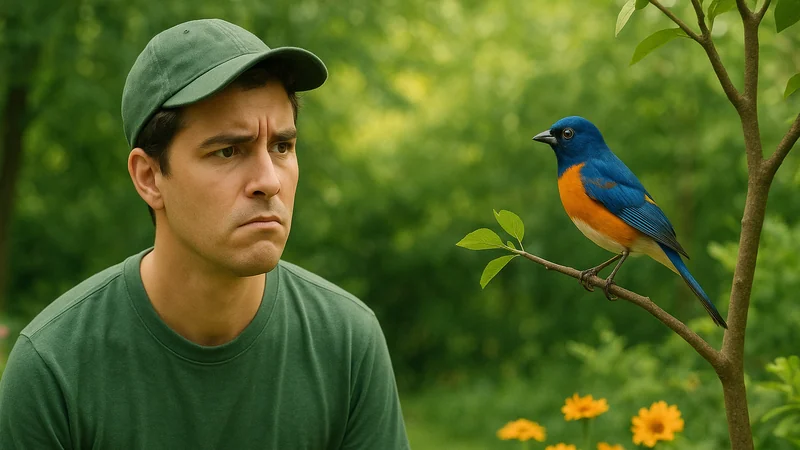
If you have watched a house finch turn into a purple finch on your screen, or heard a mockingbird logged as five different species in one morning, the fix is a diagnostic habit. Below is the practical order to follow the next time a result feels wrong.
Diagnose the miss
Separate the likely causes.
The same wrong answer can stem from very different problems. Identifying the cause tells you what to change, and backyard misidentifications usually trace back to one of five reasons that rarely overlap.
| Likely cause | What to do differently |
|---|---|
| Two birds in one clip. A cardinal and a Carolina wren singing together can push the result toward whichever call was louder last. | Wait for a gap and re-record only the target singer. |
| A mimic in the mix. Northern mockingbirds, brown thrashers, blue jays, and European starlings are commonly known to borrow phrases from other species. | Identify by sight or photo when a mimic is likely. |
| Range or habitat mismatch. A visually similar species that lives two states away can still appear if the model is not weighting your location strongly. | Sanity-check the suggestion against local range and season (which depend on your device location settings). |
| A partial vocalization. Contact chips, alarm notes, and juvenile begging calls overlap acoustically with many species. | Wait for a full song or repeated phrase. |
| Background noise treated as signal. Sprinklers, traffic, an air conditioner, wind on the mic, or a squeaky door can shift the answer. | Move away from the noise source or shield the mic. |
Before troubleshooting, ask which of these matches what you actually heard. That single question resolves most of the frustrating results.
The overlooked clue
Check the clue most people miss.
The bird you hear is often not the loudest in the recording.
The clue people overlook is the second bird in their own clip. Listen back with headphones before trusting any result. Beginners often hit record while focused on the bird they can see. Then a robin two yards over sings a phrase during that same window, and the app latches onto the closer, cleaner signal.
Another frequently missed clue is timing. A dawn chorus in April sounds nothing like the same yard in late July. If the app suggests a species that is genuinely migratory in your area and it is the wrong season, that alone is enough to reject the result and re-record. Season, time of day, and whether the bird is singing or calling all shrink the plausible list before the recognizer even runs.
A repeatable order
Try this diagnostic order.
Run these five checks in sequence. Stop when the result changes or clearly resolves.
- Isolate the singer. Wait for a gap when only your target bird is vocalizing. A five-second clean clip beats a thirty-second clip full of competing birds.
- Point the phone. Aim the microphone toward the bird, not up at the sky. Reduce wind by loosely cupping a hand around the mic without covering it.
- Get a longer sample. If a bird repeats a phrase, capture two or three full repetitions rather than a single note. Repetition helps recognizers separate a song from a chance sound.
- Cross-check visually. If you can see the bird, note its size relative to a familiar species, primary color, beak shape, and any wingbars or eye rings. Use those to sanity-check the suggested species.
- Re-run with a photo. If the sound remains ambiguous, a photo often collapses the shortlist because color and shape resolve species that sound alike.
Running the same checks every time turns a frustrating guessing loop into a short, boring routine that almost always produces a defensible answer.
Second-guess the fix
When the obvious fix is wrong.
Some intuitive corrections make identification harder, not easier. Three traps come up repeatedly:
- Getting closer. Moving within a few feet of a singing bird can distort the recording, saturate the microphone, and make the phrase sound harsher than it does in the field. Backing up a step or two often yields a cleaner sample.
- Turning up your phone's volume. That changes what you hear on playback but does not improve what the app analyzes. If the bird is faint in your clip, the answer is a longer recording or a closer bird, not a louder replay.
- Recording a mimic for longer. If a mockingbird is running through fifteen borrowed phrases, more recording just gives the app more decoys. Wait for a species that sings in a consistent, repeating structure, or use a photo if the bird is visible.
Do not trust a confident-looking single result on a marginal clip either. If you would not stake your own guess on what you just heard, treat the app's answer the same way. A tentative suggestion you verify beats a confident label you cannot defend when someone asks how you know.
Where the app fits
How Bird Call Identifier can reduce uncertainty.
Give the app more than one clue, and it has more than one way to be right. Bird Call Identifier is built around the idea that most backyard mysteries are not solved by a single input, so the workflow lets you approach the same bird from whichever angle you have.
Rather than benchmarking accuracy, the app leans on cross-checking the clues you already collected. If you want a hint that fits how casual birders decide what to install, see how to choose an ID app that fits casual backyard birding without a heavy field guide beside you.
Sound ID
Record the call or song in the app. If the clip is noisy or the bird stops singing, record again within the same session.
Photo ID
When sound is ambiguous, take or upload a picture. Color, beak shape, and markings collapse many shortlists of acoustically similar species.
Describe the bird
If you had no camera or recorder, describe what you saw instead. A description can rule out species that do not occur where you are.
Real-world accuracy was not independently benchmarked here, and no recognizer is perfect with partial or overlapping vocalizations. Agreement across inputs is a heuristic, not a validated accuracy metric: if your sound result and your photo result point to the same species, you can trust the answer more than either alone. If they disagree, the clip was ambiguous, and you should look again.
Close the loop
What to do after the next result.
A single suggestion is a starting point, not a stopping point. Treat every result as a hypothesis. Save each sighting with the date, habitat, and a note on how confident you were. Over a season, the birds you actually have in your yard will emerge as a small, recurring cast, and that context alone will make future results easier to sanity-check.
The next time an app names a species that surprises you, run the five-step order above before accepting or rejecting it. Isolate the singer, aim the mic, get a longer sample, cross-check visually, and add a photo if the sound remains uncertain. To keep sharpening the same habit outdoors, our field notes on the backyard calls people look up most walk through the species that trip up recognizers the most.
The point is to keep the diagnostic order intact: listen, record, compare, and verify. A tool is most useful when it supports that habit instead of replacing your judgment.