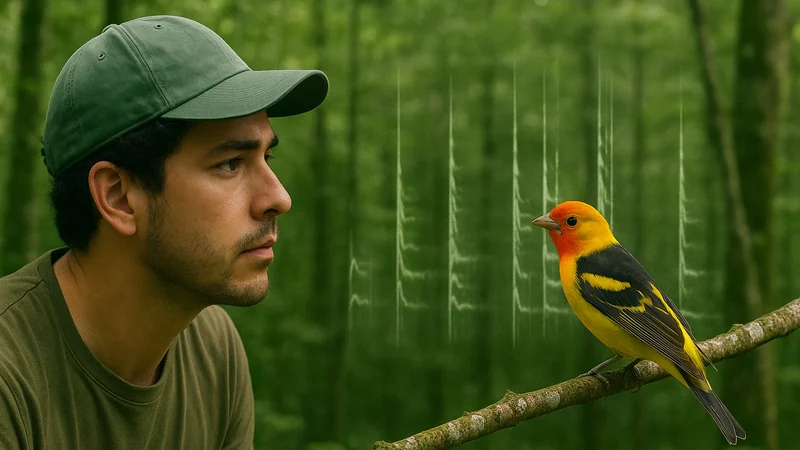
Where the answer really comes from
The recording is not what the model listens to.
You are standing under a canopy at dawn, a bright whistled phrase repeats twice, and you want a name for the singer. The short version: your phone turns that audio into an image called a spectrogram, and a neural network reads the image to rank the species it most resembles. The model never really hears the bird. It looks at a photograph of the sound.
A spectrogram plots time along the horizontal axis and pitch along the vertical axis. Brightness shows how loud each pitch is at each instant. A sharp downslurred whistle becomes a diagonal streak from high to low. A trill becomes a picket fence of vertical marks. A buzzy chip becomes a fuzzy vertical bar. Every species has a visual fingerprint, and two birds that sound alike to a human ear often look very different when drawn this way.
Published research on bird-sound identification commonly uses convolutional neural networks, the same family of models used for photo classification, trained on large public archives of labeled recordings such as Xeno-canto and the Macaulay Library. That describes the field in general, not any one app's private training pipeline. The recipe most researchers share is straightforward: slice the clip into short windows, turn each window into a spectrogram, and score each window against the species the model knows.
Change the recording and you change the picture. A distant bird gives a faint smear near the noise floor. Wind rumble paints a thick band across the bottom. Traffic paints one across the middle. If the picture is muddy, the answer will be too. That is the part that changes everything downstream.
One clue at a time
How confidence is built, note by note.
A single scored window is a guess. A useful identification is a pattern of agreeing guesses. In general terms, this is what a sound-ID engine does while you hold the phone still.
- Framing. The clip is chopped into overlapping windows a few seconds long, so a silent start does not drown out a short phrase at the end.
- Feature extraction. Each window becomes a mel spectrogram, spaced to roughly match how a human ear perceives pitch. Wind, hiss, and hum appear as visible shapes the model has to work around.
- Scoring. The network assigns a likelihood to every species it knows. Most scores sit near zero; a handful rise above the noise.
- Aggregation. Pooled scores across many windows tell a stronger story than a single frame, because a species that appears in three separate windows is far more trustworthy than one that spikes just once.
- Ranking. The top candidates come back with the strongest first. Published research also describes engines that weigh location and season, quietly lowering the score of species unlikely where you are standing; this is a general observation about the field, not a claim about Bird Call Identifier's private pipeline.
Specific engines vary, and most apps do not publish their exact pipeline. What matters in the field is that the general shape holds: a clean picture, judged across several windows, produces a confident answer, while a smudged picture produces a shortlist. When the top score feels soft, the practical next move inside the app is to record a second, cleaner clip rather than to accept the first guess.
A morning in the yard, decoded
What the model sees when you only hear a chip.
Imagine you are on a back step with coffee while something small keeps giving a single dry chip from a viburnum. To your ear, it is almost nothing: one syllable, repeated every few seconds. Suppose you record twelve seconds and let the phone work.
In a scenario like this, the first shortlist might lean toward a Dark-eyed Junco, with a Chipping Sparrow close behind. Some birders describe a junco chip as having a slightly sharper attack, and it may already be late in the season for one to be lingering, so the ranking could feel off. You move five feet closer, wait for a gap in the neighbor's air conditioner, and record again. In a case like this, the top candidate might flip to Chipping Sparrow and the next couple of clips could keep it there.
What matters in that scenario is the picture the model saw. In the first clip, the air conditioner drew a bright horizontal band across the middle of the spectrogram, right where the chip lives, so the model was guessing against a smudged image. In the second, that band was quieter, the chip stood alone, and its shape was cleaner. Same bird. Different photograph. Different confidence. When the app hesitates, the fastest fix is usually not to argue with it. It is to change the picture you are handing it.
Habits that quietly help
What experienced users do differently.
Casual users tap record once and accept the first answer. People who have spent a season with a sound identifier tend to work in loops.
- They record more than one clip. If two independent recordings agree, the answer is probably right. If they disagree, the bird is showing where the model struggles.
- They get closer and point their body, not the phone. Phones have no optical zoom for microphones. Ten feet closer, with the mic tucked away from wind and footsteps, produces a cleaner spectrogram than any digital adjustment.
- They wait for the second phrase. Many species repeat. Recording the repeat gives the model two chances at the same shape.
- They trust habitat and season. A confident guess that puts a boreal warbler in a July desert is almost certainly wrong, no matter how bright the top bar is.
- They keep the sightings. A saved list becomes a personal reference. Six weeks in, most yards reveal a short rotation of regulars, and identification gets faster because you already know the cast.
None of these are secrets. They emerge from using a sound identifier honestly for a few weekends and paying attention to when it is right and when it is not. For a broader look at how different tools behave once you take them outside, the field notes in our review of what really works when you leave the house pair well with these habits.
Known blind spots
Where every sound model gets uncomfortable.
These are situations where recognition, from any provider, tends to wobble. Independent benchmarking is scarce, so treat the pairings below as general birding habits that help you build a shorter shortlist you can actually finish inside the app, not as measured performance claims.
| Situation | What to try |
|---|---|
| Overlapping singers in a dawn chorus | Wait for a gap and record a shorter clip when one bird is dominant. |
| Mimics such as mockingbirds, catbirds, and starlings | Record a longer sequence when you can, and pair it with a photo. Even long clips may not fully resolve mimicry. |
| Juveniles and regional dialects | Cross-check with a photo or a plain-language description of size and behavior. |
| Distant, faint calls near the noise floor | Get physically closer before recording again rather than boosting volume. |
| Non-vocal sounds like wing whirs, bill claps, and drumming | Note the behavior separately and identify by sight or context instead. |
| Similar close relatives such as Empidonax flycatchers | Wait for the full song rather than isolated call notes, then save the shortlist to confirm later. |
When a responsible identifier returns a shorter shortlist, a lower top score, or a couple of near-tied candidates, that is information. It usually means your next move in the app is a second recording, a quick photo, or a saved note you can revisit, rather than a locked-in ID.
Where the app fits
Back to the canopy: naming the singer.
Everything above is general to bird sound recognition. Bird Call Identifier is built for the short outdoor clips you capture while a bird is still nearby, so each blind spot you just read about has a corresponding move in the app. The card below lines those moves up one to one.
Record the call, then break the tie.
Hit record for a short outdoor clip. The app returns a ranked shortlist with a photo and family for each candidate, so you can sanity-check the answer against the bird you are actually looking at.
- Identify birds by song, call, or chirp
- Cross-check a mimic with a photo when the shortlist keeps changing
- Describe a bird you only glimpsed to narrow the guide
- Save a close-relative sighting as a shortlist you can confirm later
The app also accepts photo and description inputs alongside sound identification. If a mimic keeps flipping the shortlist, a quick photo often resolves it. If the bird flew before you could record, a plain-language description of size, color, and behavior narrows the guide. When the app hesitates, you have three ways to break the tie instead of one.
For a closer look at what the audio step alone does, our walkthrough of how sound ID reads a single phrase zooms in on one clip from start to match.
Try it on the next bird you hear
A small, honest experiment for this week.
The best way to internalize how bird sound recognition works is to run a single clean test on a bird you already know. Pick a species that visits your yard, such as a robin, a chickadee, or a house finch, and record three clips inside the app: one close, one at a distance, and one with an obvious noise source nearby. Save each result as a sighting so you can compare the shortlists and top scores side by side later.
After that, every uncertain result in the wild will make sense, because you will know what the model was looking at when it hesitated, and whether to save the sighting, move closer, or re-record.
The useful habit is not chasing a perfect result. It is noticing when a recording gives the model enough signal to work with, and knowing when a cleaner clip is the more honest next step.