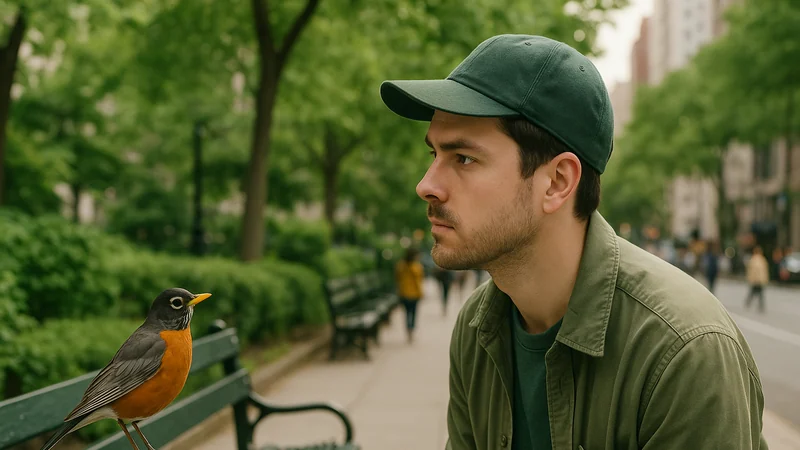
City bird identification is the practical skill of naming the birds that share sidewalks, parks, and rooftops, using a handful of quick visual and audio clues. Urban birds are a small, recurring cast: pigeons, house sparrows, starlings, crows, gulls, mourning doves, robins, mockingbirds, and a handful of hawks and warblers passing through. When a bird is hidden in a plane tree or singing from a rooftop, an iPhone identifier like Bird Call Identifier can narrow a mystery call to a shortlist you then confirm against silhouette and behavior.
The signal
Cities filter for a specific kind of bird
Concrete, glass, traffic noise, and constant human presence can look hostile, but they act as a filter rather than a wall. The birds that stay are those that tolerate people, nest on ledges rather than in tree cavities, and eat almost anything.
That filter is why the same species appear in parks in Chicago, Lisbon, and Sydney. Rock pigeons, house sparrows, and European starlings have spread widely through human activity, including deliberate introductions in North America, and now thrive on urban food sources. Native urban adapters, such as American robins in North America or blackbirds in Europe, hold their ground because lawns and hedges mimic the forest edges where they evolved to hunt.
The practical takeaway: your city's bird list is short, predictable, and stable across seasons. Once you learn ten to fifteen species, you can name most of what you see on a walk to the coffee shop, and offload the harder calls to a phone-based identifier.
Read the evidence
Four clues that do most of the work for city bird identification
You do not need binoculars. You need a quick habit of noticing four things in order before the bird moves on.
- Size against something familiar. Sparrow-size, robin-size, pigeon-size, crow-size. This eliminates most of the field in one glance.
- Silhouette and posture. A long tail held up, a hunched shoulder line, a stiff upright stance, a horizontal running gait. Shape is more reliable than color under bad city light.
- Behavior and location. Ground-hopping under a bench, hovering over a plaza, stalking a puddle, singing from the tallest antenna. Where a bird chooses to be is half of the identification.
- Sound. The two-note whistle of a chickadee, the mechanical rattle of a starling, the sharp chip of a house sparrow. Calls are how you catch the birds you never see.
Color is deliberately listed last. Feathers look gray in shade, iridescent in sunlight, and washed out under sodium streetlights. A pattern of movement is far more consistent than a swatch of plumage.
The table below maps the four clues to six species you will encounter almost daily in a temperate city park.
| Species | Size | Silhouette and behavior | Sound |
|---|---|---|---|
| Rock pigeon | Pigeon | Plump body, walking gait, head bobs forward | Low coo, wing clap on takeoff |
| House sparrow | Sparrow | Stubby tail, hops in hedges and gutters | Chatty chirps, harsh chip notes |
| European starling | Sparrow to robin | Short tail, upright stance, glossy in sun | Clicks, whistles, imitations of car alarms |
| American robin | Robin | Runs on lawns, cocks head to listen for worms | Musical caroling phrases |
| American crow | Crow | All-dark, steady flapping flight, rarely soars | Loud, hard caw |
| Herring or ring-billed gull | Larger than crow | Broad wings, soars in wide arcs over plazas | Long wailing calls, sharp yelps |
A worked example
A ten-minute bench in a downtown park
Imagine sitting on a park bench at 8 a.m. on a weekday. Here is what a beginner can realistically identify in ten minutes by working through the four clues above.
- Bird 1, at your feet. Grey and purple, walking rather than hopping, head bobbing forward with each step. Pigeon-size, ground behavior, walking gait: rock pigeon.
- Bird 2, in the hedge behind you. Small, brown, hopping with a stubby tail, chattering like an argument in a stairwell. Sparrow-size, hedge behavior, harsh chip note: house sparrow.
- Bird 3, on the lamppost. Dark, glossy in the light, running through clicks, whistles, and something briefly like a car alarm. Starling-size, mimic call: European starling.
- Bird 4, high overhead. A big bird gliding in a wide arc with long wings and spread fingertip feathers. That soaring flight over an urban plaza almost always means a gull.
- Bird 5, on the same rooftop. A slightly smaller all-dark bird flapping steadily rather than soaring, cawing hard once as it lands. Crow-size, steady flap, loud caw: American crow.
Five species, ten minutes, no book. Add a robin tugging a worm from a lawn and a mourning dove whistling as it lifts off a wire, and you have most of a typical city park's cast before your coffee goes cold.
Limits and trade-offs
The birds that will fool you
City identification is easy until it isn't. A few situations consistently trip up beginners, and it helps to know them in advance.
- Juveniles look like different species. A young starling is dusty brown with no spots, nothing like the glossy adult standing next to it. A juvenile large gull, such as a herring or great black-backed gull, can be a mottled mess for two to four years before it looks like the tidy adult in the field guide. Smaller gulls mature faster.
- Hybrids and escapees blur the lines. Feral pigeons come in checkered, white, red, and pied versions because they descend from domestic stock. A park duck may be a mallard, a domestic breed, or a mallard-domestic cross that matches no illustration cleanly.
- Migrants show up briefly and leave. Warblers, thrushes, and sparrows pass through city parks in spring and fall, sometimes for a single morning. If a bird looks unfamiliar for the neighborhood, note the date. Migration windows explain a lot, and a regional field guide organized by call and sighting is a useful cross-check when a stranger turns up.
- Sound-alikes exist. House finches and house sparrows share hedges and chirp in similar registers. Mockingbirds imitate car alarms, other birds, and construction beeps. Any single clue can mislead. Two clues that agree is a much safer identification than one clue you are sure about.
Second opinion
A phone-based check for the birds you cannot see
The hardest city birds are the ones singing from inside a plane tree at rush hour. You can hear them clearly, but you cannot see them at all. By the time you circle the tree, they have moved.
Bird Call Identifier, a free iPhone app, is built for that gap. When a bird is hidden in a plane tree, open the app, record the call with sound ID, review the suggested species, then confirm against silhouette and behavior using the four clues above. On a sidewalk with traffic and voices, this will not always yield a clean answer. What it will do is narrow the field so a mystery whistle becomes two or three candidates you can weigh.
The app also handles the reverse problem. When you get a good look at a bird you cannot name, take a photo and use photo ID to see likely species. Save the sighting, and it becomes part of a running list of the birds on your street, which is a more useful field guide over time than any book because it reflects your actual neighborhood. Two limits worth stating plainly: no sound identifier is perfect in noisy conditions, and short or muffled recordings return uncertain results. Treat any single result as a lead to confirm, not a verdict. The app is currently iPhone only. For a broader sense of how at-home tools handle familiar species, the same four-clue habit works for birds outside your kitchen window.
In the field
Build a neighborhood list in a week
The most useful thing you can do next is not to memorize a national field guide. It is to learn the birds on your specific block, in the order they show up.
Start with a seven-day habit. Take a five-minute walk at the same time each morning and write down every bird you can identify, even if the list is just pigeon and sparrow on day one. By day three, you will notice a crow that always perches on the same streetlight. By day five, you will recognize the mourning dove that whistles as it lifts off a wire. By day seven, you will have a personal core list of five to ten species, and any bird not on that list will stand out immediately as worth a closer look.
That is the practical version of city bird identification: a short, honest list of the regulars, four clues checked in order, and a phone in your pocket for the sound coming from the tree you cannot see into.
On your next walk, identify one sound before you look for the bird. A single confirmed regular is enough to begin a neighborhood list that gets more useful with every route you repeat.