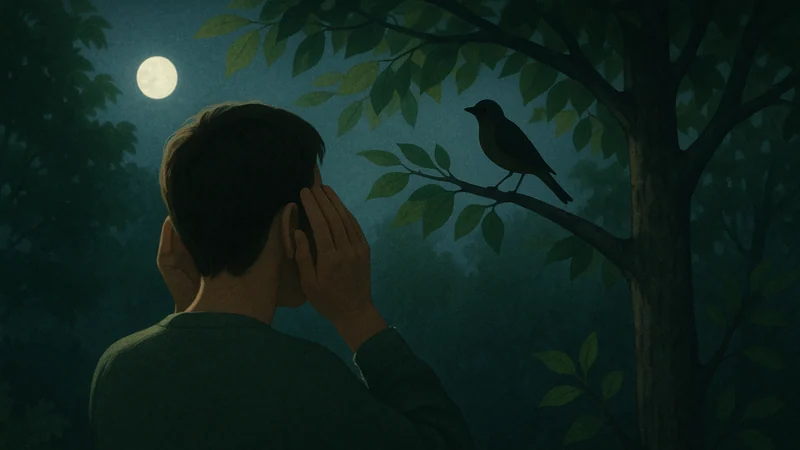
If a bird is belting out full song in the dark, especially somewhere in North America or Europe, the most likely culprit is a Northern Mockingbird, a European Robin near a streetlight, or, in early summer, an unmated songbird still trying to attract a partner. Owls hoot. Nightjars churr. But a bird performing a real, varied song at 3 a.m. is almost always one of a small, predictable cast. (Species in other regions differ; the diagnostic order below still works, but the likely culprits change.)
Separate the likely causes
Nighttime bird sound falls into four buckets, and they sound nothing alike once you know what to listen for. Confusing them is why people give up.
- True nocturnal birds. Owls, nightjars (like the Eastern Whip-poor-will or European Nightjar), and nighthawks. Their sounds are hoots, whistles, or mechanical churrs, not melodic song.
- Diurnal birds singing at night. This is your 3 a.m. singer. Mockingbirds, thrushes, robins, and warblers occasionally perform full song after dark, often triggered by artificial light or an unpaired territory.
- Migrating birds calling overhead. Short, sharp tseep or chip notes from birds moving in the dark during spring and fall migration. Easy to mistake for something in your yard.
- Non-bird sounds. Tree frogs, cicadas, katydids, and even some mammals get miscounted as birds. If it's rhythmic and mechanical for hours, it's probably an insect or amphibian.
Once you can tell those four apart, the mystery shrinks fast.
Check the clue most people miss
The single most useful clue is not the sound itself. It's whether the bird is repeating the same phrase or changing it every few seconds.
A Northern Mockingbird runs through a rotating catalogue: a phrase two or three times, then a completely different phrase, then another. If your 3 a.m. singer sounds like it's auditioning through a whole playlist, you almost certainly have a mockingbird. Unpaired males are widely reported as one of the most common sources of nighttime song across the southern and central United States, and they are famously drawn to streetlights, porch lights, and full moons.
A bird repeating one steady phrase points somewhere else. Use the table below as a quick structural filter before you commit to a species.
| Song structure | Likely species | Region | Typical trigger |
|---|---|---|---|
| Rotating phrases, endless variety | Northern Mockingbird | US and Mexico | Unpaired male near a streetlight |
| Slow, fluty, rising and falling | Hermit Thrush or Wood Thrush | Eastern North America | Pre-dawn edge |
| Rich, varied warble from a hedge | European Robin | UK and much of Europe | Urban light pollution |
| Loud, liquid, virtuosic | Common Nightingale | Southern Europe and western Asia | Late spring territorial song |
People miss this clue because they focus on how pretty the sound is. Structure is what identifies the bird.
Try this diagnostic order
Work top to bottom. Stop at the first step that gives you a clear answer.
- Note the time and location. Genuine 2 to 4 a.m. singing narrows the field. So does your region: mockingbirds dominate suburban North America, robins dominate lit European towns, nightingales appear in specific European habitats in late spring.
- Listen for structure. Rotating phrases equal mockingbird. One repeated phrase equals thrush, robin, or nightingale depending on where you are.
- Listen for a hoot or churr instead of a melody. That flips you into the owl and nightjar family, not a songbird.
- Check for a streetlight or porch light near the sound. Artificial light is one of the strongest known drivers of nighttime song in songbirds that would otherwise wait for dawn.
- Note the calendar. Late April through June, unmated males sing longest and latest. In fall, brief overhead tseep notes usually mean migrating warblers or sparrows passing over the house.
- Record a clip. Even ten seconds on a phone is enough to identify the bird later, especially once you're too tired to keep guessing.
Most 3 a.m. mysteries are solved by step two or step four.
When the obvious fix is wrong
A few situations trip people up every year. Match each assumption to what is actually happening.
- It sounds like an owl because it's dark. Owls have a limited vocabulary of hoots, screeches, and whinnies. If the sound is musical, varied, or long, it isn't an owl. The Eastern Screech-Owl's tremulous whinny gets mistaken for a horse; the Barred Owl's who cooks for you is unmistakable once you've heard it named.
- You call it a nightingale because it's beautiful. Outside a narrow slice of Europe and western Asia, it isn't a nightingale. In North America, the beautiful nighttime singer people romanticize is almost always a mockingbird or, occasionally, a thrush at the dawn edge.
- You assume the bird is in trouble. Most nighttime singers are healthy unpaired or light-exposed territorial males doing normal behavior. Genuine emergencies, such as a bird stunned after a window strike or a fledgling grounded near a light, are worth checking on; a bird belting out song from a perch usually isn't one of them.
- People also assume silencing the yard will help. The bird is responding to territory and light, not to you. Reducing outdoor lighting near a favored perch is the one intervention that sometimes changes the behavior, and it takes several nights to show any effect.
- A steady, unbroken trill gets blamed on a mockingbird. A trill or buzz that runs for minutes without pause is almost never a bird. Katydids, tree crickets, and cicadas are the usual sources, and they can sound startlingly musical through a bedroom window.
How Bird Call Identifier can reduce uncertainty
Ear-based ID at 3 a.m. is hard for a reason: you're half-awake, the sound is muffled by walls, and you have nothing to compare it to. This is exactly what a sound recognition app is built for.
Bird Call Identifier is a bird identifier app for iPhone. Open it at the window, record a short clip while the singer is still performing, and it matches the sound to a species and returns the bird with photos and details. You can also identify a bird by photo or by description, and save the sighting to check whether the same singer returns the next night.
A few honest caveats worth naming. No sound ID is perfect. Heavy rain, wind, and traffic all degrade recordings. Double-glazed windows dampen the signal further. Overlapping songs at true dawn chorus can produce more than one candidate. Treat the app's match as a strong hypothesis, then confirm it with the structural clues above, especially the phrase-rotation test for mockingbirds. For a closer look at what a recognizer is actually doing when it listens, this walkthrough of how sound recognition reads a bird call covers the parts of the signal it leans on most.
What to do after the next result
Once you have a candidate species, treat the next few nights as confirmation, not case closed. A single 3 a.m. recording is a lead. Three matching recordings over a week, from the same direction, is an identification.
- Log the time and weather. Note whether the bird sings on clear nights, moonlit nights, or only when a nearby light is on. Patterns show up quickly.
- Move the microphone, not the bird. A second recording from a different window or the back porch often produces a cleaner match than turning up the volume on the first one.
- Compare against a daytime recording. If you can catch the same singer at dawn, when the sound is louder and clearer, the species ID becomes much more confident.
- Decide what, if anything, to change. If a porch light is clearly driving the singing, try a warmer bulb, a shield, or a timer for a week and see whether the concert moves.
If you want to pressure-test the tool you used, this short field checklist for judging whether a bird ID app is trustworthy is a useful reference to keep bookmarked before your next nighttime session.
The next diagnostic action is simple: keep your phone within reach tonight, and the next time the singing starts, record ten seconds before you do anything else. That short clip is what turns a recurring annoyance into a bird you actually know.