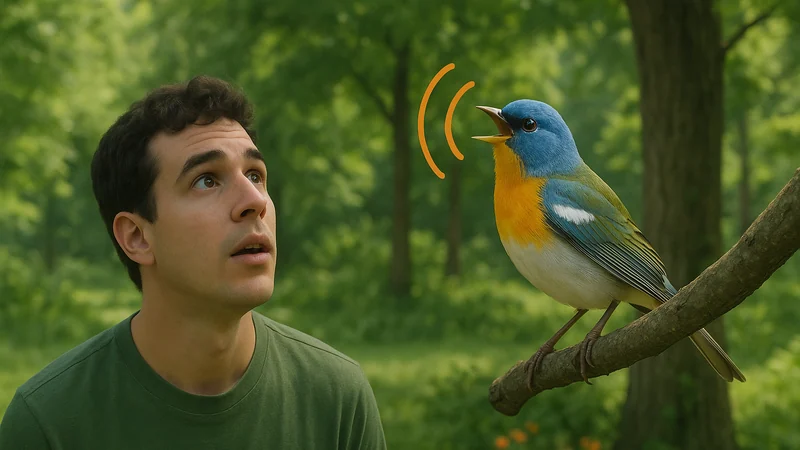
You heard it clearly: a bird outside your window is making a noise that belongs in a hardware store, a sci-fi film, or a parking lot. A squeaky-toy note from a pine often traces to a Brown-headed Nuthatch, and a rooftop "car alarm" cycling through unrelated sounds is usually a Northern Mockingbird or a European Starling running through borrowed phrases. The full shortlist and how to confirm it sit just below.
The one detail that changes the whole answer
Before you compare notes with any list, decide where you are and what the sound is doing. The same sharp squeak can come from three different birds depending on habitat, time of day, and whether the note is a single call or a repeated song. A backyard suet feeder at 7 a.m. narrows the field to a handful of common visitors. A wooded trail at dusk opens up an entirely different cast.
Sound alone rarely gives you a single species. Sound plus context usually does. So before you guess, note four things: where you are (yard, forest, wetland, city block), the time of day, whether the sound is one short note or a longer phrase, and whether it repeats on a steady rhythm.
Sound map
A mapping table for the sounds people actually hear
Most "what bird sounds like" searches trace back to the same short list of oddly mechanical calls. The table below matches everyday sound descriptions to the birds most often behind them, with the "Likely candidates" column ordered from most to least common in typical yards and parks. Treat these as common listener impressions, not taxonomic groupings or a guaranteed ID.
| What it sounds like | Likely candidates | Where you probably heard it |
|---|---|---|
| Squeaky dog toy or rubber duck | Brown-headed Nuthatch, young Blue Jay, Black-and-white Warbler (migration in deciduous woods) | Pine woods, wooded yards, forest edges |
| Laser blast or sci-fi zap | Bobolink, Common Grackle, European Starling mimicry | Open fields, farmland, parking lots, city rooftops |
| Car alarm cycling through tones | Northern Mockingbird, European Starling, Gray Catbird | Suburbs, shopping centers, hedgerows |
| Rusty gate hinge or squeaky wheel | Common Grackle, Brown-headed Cowbird | Lawns, parks, mixed flocks in trees |
| Whistled two-note "fee-bee" | Black-capped Chickadee, Eastern Phoebe | Backyards, woodland edges |
| Whinnying laugh or descending trill | Eastern Screech-Owl, Northern Flicker, Downy Woodpecker | Wooded neighborhoods at dawn or dusk |
| Repeated "who cooks for you" | Barred Owl | Wet woods, swampy edges, some suburbs at night |
| Sharp electronic "peent" overhead at dusk | Common Nighthawk | City skies and open ground at twilight |
| Nasal "peent" from the ground at dusk | American Woodcock | Damp forest openings and old fields in spring |
| Cat mewing from a bush | Gray Catbird | Dense shrubs, garden hedges |
| Referee whistle or slide whistle | Northern Cardinal, Tufted Titmouse, Baltimore Oriole | Backyards, wooded parks |
This shortlist skews toward North American species and common backyard settings. Regional variation, season, and individual birds all shift these associations, so use the table as a starting point and let habitat, range, and a recording finish the ID.
Building confidence one clue at a time
Once you have a shortlist, layer in clues in a specific order. Skipping ahead is where most beginner IDs go wrong, and a quick recording plus a sound ID app is how most birders eventually close the loop on a strange call.
Start with rhythm, not tone
Is the sound a single note, a two-note phrase, a trill, or a long song? Rhythm is more reliable than tone because it varies less between individuals. A car-alarm-style bird cycling through six unrelated phrases in a row is almost always a mockingbird or starling doing mimicry. A steady, mechanical two-note repeat is a different family entirely.
Habitat is your second filter
If you are standing under pines and hearing a squeaky-toy note, Brown-headed Nuthatch jumps up your list. In a treeless field, the same description points more toward a Bobolink's bubbling, laser-like song. The same three seconds of audio can mean two different birds depending on the trees around you.
Watch what the singer is doing
Is the bird perched high on a wire, hidden in a shrub, or flying over? Mockingbirds sing from exposed high perches. Catbirds stay tucked inside dense cover. Nighthawks make their electronic peent while flying overhead at twilight. Behavior often confirms what your ear suspected.
Close the loop with a recording
Memory of a bird sound fades quickly, especially once another one starts singing over it. A short recording gives you something concrete to compare against a known reference, or to run through a sound identification tool while the details are still intact.
A real morning in the yard
Picture a Saturday in late May. You are on the back patio with coffee. From the maple across the fence comes what sounds exactly like someone squeezing a rubber duck, over and over, every two seconds. Then from the roofline: a rising electronic squeal followed by a rusty gate creak followed by a car alarm's exact chirp-chirp-chirp.
Two birds, two very different puzzles.
The squeaky toy in the maple, given the tight repetition and the presence of a nearby pine stand, is likely a Brown-headed Nuthatch. The rooftop performance, cycling through unrelated mechanical sounds without ever settling, is most likely a European Starling running through its mimicry library. The clue was not the individual sounds but the sequence: real bird species tend to repeat their own song. Starlings and mockingbirds jump between borrowed sounds.
You pull out your phone, record fifteen seconds of each, and now you have something to work with instead of a memory that will be gone by lunch.
What experienced birders do differently
Regulars are not memorizing every song in North America. They are running a small set of habits that beginners often skip.
- They record first, identify second. The bird will not wait. A recording will.
- They log the context. Date, location, and habitat get noted before the ID does, because those details often decide between two similar candidates.
- They accept "unknown" as a valid answer. Not every sound gets identified. A dawn chorus can layer eight species on top of each other, and even good ears leave some threads unpulled.
- Cross-check the suggestion. When a sound ID tool proposes a species that would be well out of range or wrong for the habitat, treat it as a flag to look again, not a final answer.
- Learn by association. Once you have seen a Gray Catbird actually mew from a hedge, you will never mistake that sound again. Pairing the sound with a sighting locks it in far faster than flashcards.
For the everyday cast most beginners meet first, our walkthrough of the backyard bird sounds people search for most is a useful next read.
Where the app helps
Where Bird Call Identifier fits the moment
That thirty-second gap between hearing a strange sound and knowing what made it is exactly the moment Bird Call Identifier is built for. Open the app, tap the Record button, capture the sound, and let it match the audio to a likely species. If you also catch a glimpse of the bird, you can identify it from a photo, and when you have neither a clean recording nor a clear shot you can describe what you saw and heard to narrow the field.
A few honest expectations:
- Sound identification works best on clear, close recordings of a single bird.
- Dawn choruses, wind, distant traffic, and heavy overlap all lower confidence.
- Treat any suggestion as a strong lead and confirm it with habitat, range, and behavior before you call it a positive ID.
The tool narrows the field. Your context finishes the ID. If you want a deeper look at what a sound ID app should and should not promise, our take on what a good bird identifier app should actually do covers the trade-offs in more detail.
Your next step outside
The fastest way to get better at strange bird sounds is not to memorize a list. It is to build a habit: hear something odd, record ten seconds, note where you are, and identify it while the moment is still fresh. Do that five weekends in a row and the squeaky toys, lasers, and car alarms in your neighborhood start turning into a small cast of familiar characters you recognize by ear.
Next time a mechanical squeak drifts in from the trees, have the recorder ready.
When an odd sound drifts in from the trees, record a short clean clip and note where it came from. The combination of sound, place, and timing is usually more useful than the noise alone.