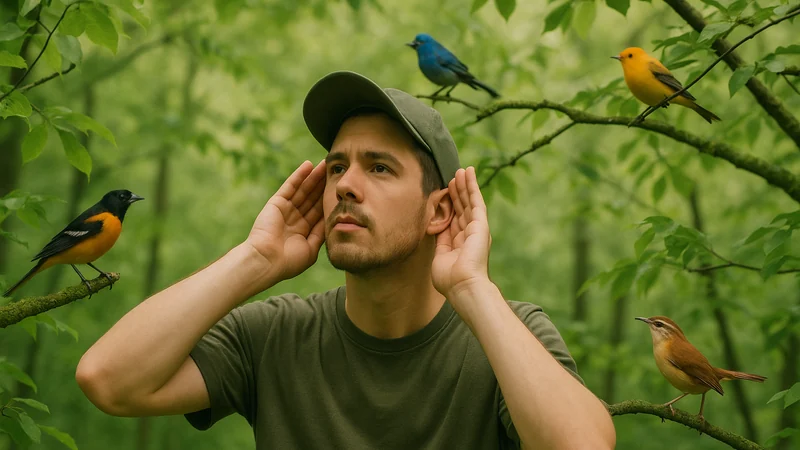
Myth
The assumption to leave behind.
The old assumption is that you have to memorize hundreds of songs before you can identify anything by sound. That is why most beginners give up after a week of flashcards.
Birding by ear does not start with memorization. It starts with sorting. Every common call belongs to a small handful of sound families, and once you hear the family, the species narrows itself down. A chickadee and a blue jay do not sound alike because they use their voices for different jobs: one is a social contact call, the other is a territorial broadcast. Your brain is already good at this kind of sorting; it does it with human accents and car engines. You just have not aimed it at birds yet.
The other assumption worth dropping is that a bird sound is a single event. It rarely is. Most vocal birds repeat a phrase, pause, then repeat it again in a slightly different key. If you catch yourself thinking "I only heard it once," wait ten seconds. You will almost always hear it again, and the repetition is often the identification clue, not the note itself.
Method
What works instead.
Before you try to name the bird, sort the sound by four traits: pitch, pattern, tone, and place. A single illustrative case shows why the sort works. A steady mechanical trill from a suburban lawn at midmorning is not a mystery once you sort it: middle pitch, repeated pattern, dry tone, open habitat. That combination points to a chipping sparrow or a dark-eyed junco in many regions before you consider a single note.
Pitch, the size clue
Pitch often indicates the size and family of the singer. Very high, thin notes typically belong to small songbirds such as warblers, kinglets, and waxwings. Middle-range whistles suggest cardinals, robins, and titmice. Low hoots, coos, and croaks come from doves, owls, and corvids. If a call sounds physically high in your ear, it is rarely a crow or a mourning dove.
Pattern, the rhythm clue
Pattern is the rhythm. Is it a single note repeated, a two-note phrase, a trill, a buzz, or a whole musical sentence? Single, sharp notes are usually contact or alarm calls. Repeated musical phrases are territorial songs. Long, dry trills often belong to sparrows, juncos, or pine warblers.
Tone, the texture clue
Tone is the texture. It can be clear and flute-like, harsh and buzzy, nasal, whistled, or scratchy. A jay's harsh scream and a robin's clear caroling can sit at a similar pitch but have wildly different tones, and that texture is often the fastest species clue you have.
Place, the context clue
Place is where you are standing. A call at dawn from a marsh edge is not the same as a call at noon from an oak canopy. Habitat and time of day cut your candidate list in half before you even consider a single note.
Decision tree
A compact method to follow.
Run the sound through these four questions in order. By the fourth answer, you usually have a short list of two to three species.
- Is the pitch high, middle, or low? High and thin points to warblers, kinglets, waxwings, and goldfinches. Middle suggests cardinals, robins, titmice, and sparrows. Low points to doves, owls, crows, and ravens.
- Is the pattern a single note, a repeated phrase, a trill, or a full song? Repeated phrases usually mean a territorial song; a single sharp note usually means a contact or alarm call.
- Is the tone clear, buzzy, nasal, or harsh? Clear whistles push you toward cardinals and titmice; buzzy or nasal tones push you toward jays, nuthatches, and some warblers.
- Where are you, and what time is it? Suburban yard at dawn, wooded trail at midmorning, wetland edge at dusk, and city park at noon each carry their own short list.
Try it on the next mystery call. In much of the eastern U.S., high, repeated, clear, suburban dawn often points to a Northern Cardinal or a Tufted Titmouse. A low, monotonous, cooing, suburban afternoon usually resolves to a Mourning Dove. A middle-pitched, harsh, scolding, oak-canopy call is often a Blue Jay. You have not memorized anything. You have sorted.
The one-line takeaway: pitch, pattern, tone, and place, in that order, will narrow most common calls to a short list before the bird sings again.
Exceptions
When the rule has exceptions.
Two categories of birds bend the decision tree, and it helps to know them by name so you are not surprised.
Mimics that borrow phrases
Northern Mockingbirds, Gray Catbirds, and Brown Thrashers borrow phrases from other species and string them together. If a bird seems to be running through five species in a row without pausing, you are likely hearing a mimic, not five different birds. As a general rule of thumb, with plenty of individual variation:
- Mockingbirds tend to repeat each borrowed phrase three or more times.
- Catbirds usually give each phrase once.
- Thrashers often repeat each phrase twice.
Coincidental sound-alikes
Some birds sound like others by coincidence. Scarlet Tanagers are often described in birding lore as a robin with a sore throat because they share the robin's phrasing but with a burry tone. European Starlings are well known for mimicry and can produce whistles that resemble a Northern Bobwhite or a killdeer. Young birds and molting adults sometimes produce partial or off-key versions of the adult song. When the sort does not resolve cleanly, assume you might be in one of these gray zones and treat your answer as a best guess rather than a certainty.
Weather and season matter too. Fall and winter reduce full song and increase short contact calls, which are shorter, drier, and harder to pin down than spring song. If you are birding in October and everything sounds like a chip, that is the season talking, not your ear failing you.
In the app
How Bird Call Identifier supports the method.
Say your sort has narrowed a mystery call to two candidates and the bird is still hidden in the canopy. That is the moment the app is built for: a quick recording that serves as a tiebreaker on your short list, not a replacement for the sort you just did.
Bird Call Identifier is a free bird identifier app for iPhone. In the field, the workflow is simple: record the call, let the app match it to a species, and save the sighting so the same voice in the same yard next week is instantly familiar. The app can also work from a photo you already took when the bird pops into view.
The honest limit is worth naming. No sound identifier, including this one, is right every time, and accuracy varies with distance, background noise, and how much clean song the clip captures. Dense dawn choruses, distant birds behind traffic noise, and mimics all increase the chance of a wrong guess. Treat the app's top match as the strongest candidate on your short list, not as proof.
Two habits get the most out of it:
- Record a few seconds of actual song, not the pause between phrases.
- Save the sighting when you are confident, so recurring visitors become one-tap recognitions.
Curious what the app is actually listening for inside your clip? The companion piece on what a sound recognition engine hears in a short outdoor recording pairs well with this decision tree.
In the field
Use the insight in practice.
Picture this: it is a Saturday morning. You are refilling coffee when a bright, repeated two-note whistle drifts in from the maple by the driveway. You do not know the bird. You do not need to yet.
You run the sort in your head. Middle pitch, not low. Repeated phrase, not a single chip. Clear tone, not buzzy. Suburban yard at dawn. Your short list is already down to two or three familiar suburban singers before you even open a door. You step outside, hold your phone toward the maple, record ten clean seconds, and let the match either confirm the sort or hand you a candidate you had not considered. Then you save the sighting so that the next time that same voice returns, you already know your neighbor by name.
That is the practical loop: sort first, record second, save third. Over a season of doing this, you stop needing the app for the common ten birds around your home and start using it only for the genuinely tricky ones. When the next mystery call arrives at your window, bring the sort and the app together.