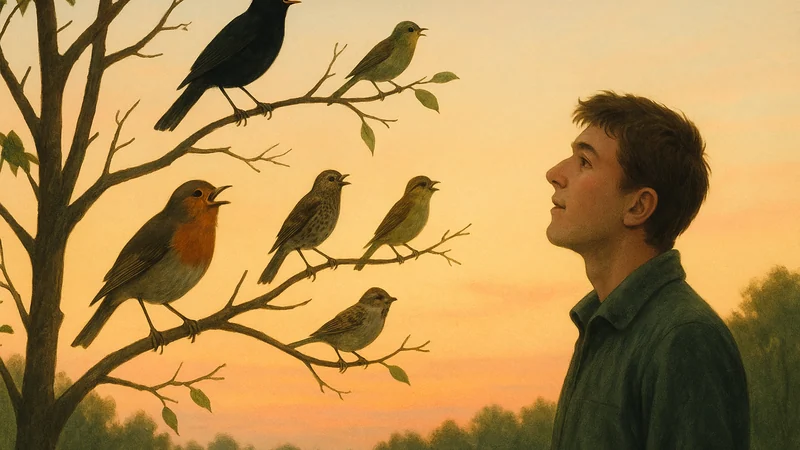
Birds sing at dawn because it is the single best window of the day to be heard. Cool, still air carries sound farther, light is too dim for most foraging, and males are advertising territory and fitness to females before the day's work begins. If you are hearing a layered chorus outside your window, you are listening to dozens of overlapping territorial broadcasts, not a random burst of cheerfulness.
That is the short answer. The harder part is telling those voices apart, and knowing what to do when the chorus does not behave the way you expect.
Separate the likely causes
Most morning singing collapses into a few overlapping motivations. Reading the chorus gets easier once you stop treating it as one sound and start hearing it as several jobs happening at once.
- Territory defense. Males announce, from a favored perch, that a patch of habitat is taken. This is the loud, repetitive singing you hear from the same tree morning after morning.
- Mate attraction. Song quality, length, and variety serve as an audition. Unpaired males often sing longer and harder than paired ones, though this varies by species.
- Pair contact. Softer duet-like exchanges between a bonded pair can sound like conversation rather than performance.
- Alarm and contact calls. Short, sharp notes woven through the chorus are not song at all. They are calls, and they mean something different.
The distinction between song and call matters more than most beginners realize. Mixing them up is one of the fastest ways to misidentify a bird, so it helps to understand how song and call each narrow a species differently.
Check the clue most people miss
The clue is timing within the chorus itself. The dawn chorus is not a single event; it is a rolling schedule. Different species tend to start singing at slightly different light levels, and that order is surprisingly consistent from morning to morning in the same yard.
The most useful thing you can do is listen for the first solo voice before any overlap begins. That opening singer, cleanly isolated for maybe thirty seconds, is often the easiest identification of the whole morning. Miss it, and you are already trying to untangle two or three voices at once.
In many temperate yards, robins and thrushes often lead. Wrens and warblers tend to layer in as light grows. Sparrows and finches typically join later, when the air has warmed enough for insects to move. Regional and seasonal mixes vary, but the pattern of an early solo followed by rolling layers is broadly reliable.
| Light level | Typical singers | What to listen for |
|---|---|---|
| Pre-dawn | Robins, thrushes | A single clear voice with no overlap |
| First light | Wrens, warblers layering in | Two or three voices you can still separate |
| Fifteen minutes after | Full chorus | Dense overlap; pick the nearest singer |
| Sunrise | Sparrows, finches | Earlier singers going quiet as insects stir |
If you have been trying to identify the whole chorus at once, you have been trying to solve a puzzle where the pieces keep changing. Standing outside for two minutes at first light, then again fifteen minutes later, then again at sunrise, gives you three separate, thinner soundscapes that are far easier to pick apart.
Try this diagnostic order
When the chorus feels like noise, work through it in a fixed sequence instead of guessing. This is the order that tends to fail least often.
- Fix your position. Stop walking. Face the loudest source. Sound direction is the first piece of information you lose the moment you move.
- Count the distinct voices. Not species, voices. How many different phrases repeat? Two? Five? Ten? Knowing the number keeps you honest about what you can actually resolve.
- Pick the closest one. Ignore the far singers for now. The nearest bird is loudest, cleanest, and easiest to isolate.
- Note the pattern. Is it a repeated phrase, a long tumbling warble, a two-note whistle, a trill? Rhythm is more diagnostic than pitch for most beginners.
- Record a short clip with Bird Call Identifier. Even a rough recording preserves the moment so the app can suggest a species after the chorus has moved on.
- Then look. Only after you have a sound in your ear or on your phone, try to spot the singer. Looking first almost always fails at dawn because the light is against you.
This order works because it front-loads the information that decays fastest: direction, proximity, and the sound itself. Visual ID can wait; the chorus cannot.
When the obvious fix is wrong
A few common instincts backfire at dawn. Recognizing them saves a lot of frustration.
- Cupping your ears at everything. Amplifying the whole scene just gives you a louder wall of sound. Cup one ear toward a single perch instead, so you narrow rather than widen.
- Walking closer to the loudest bird. Territorial singers often stop the moment a human steps into their patch. If you stay still longer than feels natural, they usually resume from the same or a nearby perch.
- Assuming the biggest voice is the biggest bird. Wrens, warblers, and small sparrows produce disproportionately loud song, and a tiny bird in a shrub can out-sing a crow at close range.
- Trusting the first identification your brain offers. Familiarity bias is strong at dawn: if a robin sings in your yard every morning, your brain will file ambiguous songs as robin. Name one specific feature of the song before you commit to a species.
- Blaming your ears when the chorus goes silent. A sudden hush often signals a nearby predator, though weather shifts, human movement, or a natural pause can have the same effect. Give it a minute or two; the first bird back is often worth identifying.
How Bird Call Identifier can reduce uncertainty
Bird Call Identifier is built for exactly this moment: a sound you can hear clearly but cannot name, in an environment where you cannot see the singer. You record a short clip from your phone, and the app suggests a likely species from the audio. When you catch a glimpse instead, you can identify the bird from a photo you take on the spot or already have on your camera roll.
A few honest limits are worth keeping in mind. No sound identifier is perfect, and the conditions that make dawn magical are also the conditions that stress any recognition tool.
- Overlapping songs from three or four singers at once.
- Wind, distant traffic, and household noise on the recording.
- Unfamiliar regional dialects the model has less exposure to.
Treat any suggestion as a starting point to cross-check, not a verdict. Compare it against the pattern you noted, the habitat you are standing in, and the time of year. When the suggestion matches your field notes, you have a solid identification. When it does not, that mismatch is itself useful information: it usually means you were listening to a different bird than the one you thought was singing. If you want the backstory on why the app was built around this exact field problem, the note on building a free bird identifier for iPhone is a short read.
The app also lets you save the birds you identify, so one morning's mystery becomes a growing personal record of who sings where and when. Over a few weeks, your own log becomes the most accurate dawn-chorus reference for your specific yard, block, or trailhead.
What to do after the next result
Once the app returns a species, do three things before you close it.
- Play back a reference clip. Listen to a known recording of that species and match it against what you just heard. If they line up, save the sighting.
- Note the time and the perch. Dawn singers are creatures of habit. The same bird will likely sing from the same tree at roughly the same light level tomorrow, giving you a repeatable test.
- Pick one nearby voice you did not identify. Come back to it tomorrow at the same hour. Working one unknown bird at a time is how the chorus stops being a wall and starts being a cast of characters.
If you want a shortcut for the trickiest part, deciding whether a sound is a song, an alarm, or a contact call, a quick decision tree for common backyard calls will get you there faster than reading species accounts one by one.
Tomorrow morning, step outside at first light with your phone ready to record. Capture the first clear voice you hear, before the chorus thickens. That single clip, worked through the order above, will teach you more than an hour of listening without a plan.
At first light, record one clear voice before the chorus gets crowded. Compare the clip with the time, habitat, and any visual clue you caught; that small routine makes the answer more trustworthy.