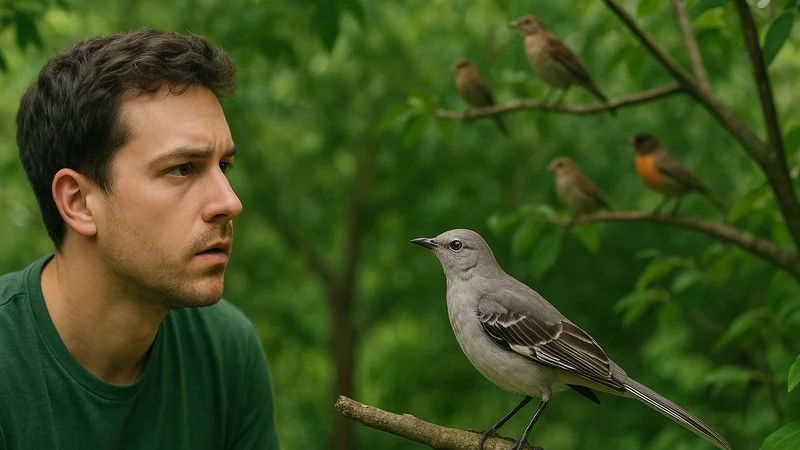
The mistake behind the problem
Treating one recording as one answer is the usual trap. You hear a cardinal-like whistle, a jay-like squawk, and a wren-like trill in the same tree, record each, and expect three species. The app returns Northern Mockingbird again and again, and it looks like a bug.
Nothing is broken. A single male mockingbird can cycle dozens of copied phrases from one perch for minutes at a time, so your clip captures the mimic performing the imitation rather than the bird being imitated.
Another common misconception is that this only happens in the South. Northern Mockingbirds are common across most of the continental United States, into southern Canada, and across much of Mexico. If you live near open lawns, hedgerows, parking lots, or suburban shrubs, a mockingbird can be your loudest neighbor and your most deceptive soundtrack.
Why it seems convincing
Mimicry works because the copy is good. A mockingbird's Carolina Wren imitation matches the wren's rhythm and pitch contour. Its Blue Jay imitation catches the sharp downward slur. To your ear the copies pass as the real bird, so when the app labels the whole sequence as a mockingbird you feel corrected by a machine that seems to have missed the obvious answer.
Two things separate the mimic from the model, and both are easy to hear once you know what to listen for.
Mockingbird tells vs. model bird tells
| Mockingbird tell | Model bird tell |
|---|---|
| Each phrase repeats several times, commonly cited as two to six, before changing | Sings one species-typical song and stays with it |
| Rapid variety: wren, cardinal, car alarm, robin inside a minute | Consistent rhythm and pitch shape across the whole song bout |
| Sings from an exposed perch: fence, antenna, bare branch | Usually calls from typical cover for the species |
| Can sing under streetlights at night, especially unpaired males | Most songbirds fall silent after dusk |
If you hear three or four different species in quick succession from one perch, you are almost certainly listening to a single mimic, not a group of birds.
A better way to test the situation
One clip of a suspected mimic rarely tells the full story. Give the app enough context to read what is happening on that perch and the results become far more trustworthy.
- Watch the perch before you press record. Look for a slim gray bird with a long tail, white wing patches in flight, and a habit of singing from exposed spots such as fences, antennas, or bare branches.
- Record for a longer stretch. Capture a continuous sequence so the clip shows the shifting variety that marks a mimic.
- Take a second recording after moving a few steps. If clips from the same perch keep returning mockingbird with varying phrases, the pattern is confirmed.
- Record any suspected model separately. Walk toward a nearby cardinal and record it directly; two recordings from different locations that agree are far more revealing than one clip.
- Note the time and setting. Mockingbirds are famous for singing through the night under streetlights and during spring moonlight, especially unpaired males, so a varied song at 2 a.m. in a suburban yard is a strong clue.
A quick diagnostic checklist for a mockingbird result
Run through these five questions the next time your app returns mockingbird for a song that did not sound like the mockingbird you expected.
- Did a single perch produce multiple different songs within a minute?
- Did specific phrases repeat between two and six times before shifting?
- Is the singer a slender, long-tailed gray bird sitting out in the open?
- Are you in a suburb, park edge, hedgerow, or roadside area?
- Is it nighttime or bright moonlight, with one singer performing strongly?
Three or more yes answers means you can trust the mockingbird result and stop searching for the ghost species inside it. If most answers are no, try the steps for what to do when your app returns an unknown result instead.
What a useful result looks like
A helpful ID for a mimicry moment is not just a single species name. It is a small map of what is on that perch and nearby. After the quick experiment above, a good outcome might read: the singer on the fence is a Northern Mockingbird cycling copied phrases, a real Northern Cardinal calls from the oak two houses away, and the wren-like burst is part of the mockingbird's sequence rather than a separate bird.
That reframes how you use the app. Instead of waiting for a single verdict, you use recordings to describe a scene. A mockingbird result stops looking like a bug and starts looking like the clue that explains everything else you heard.
Where Bird Call Identifier helps
For a rotating mimic, the workflow that helps most is short and repeatable: record the singer, take a few steps, record again from the same perch, and compare. Bird Call Identifier is built for exactly that loop, so you can hold several minutes of one bird next to each other instead of judging a single clip.
The app offers a few capabilities that fit the mimic scenario:
- Identify by sound when the singer is hidden in a hedge or high in a tree.
- Identify from a photo when the mimic is visible on a wire or fence post, so an image can confirm the bird in front of you.
- Identify from a written description as a starting point when you only remember the scene later, used alongside a recording rather than on its own.
No sound identifier is foolproof, and mimicry can occasionally trip one up. Pairing a recording with a photo or a quick description is a useful workflow habit rather than a guaranteed accuracy boost.
To sharpen your ear for the birds a mockingbird tends to copy, spend a morning with the backyard songs mockingbirds most often imitate. Recognizing the models makes the mimicry obvious.
Build a more reliable habit
The habit that resolves mockingbird confusion is a single decision made before you press record. When you see a slim gray bird with a long tail sitting in the open and the song keeps changing character every few phrases, decide up front that the likely answer is a mockingbird and record a full minute to confirm the rotation. That single moment of naming what you see before you name what you hear is what keeps the app from spending your morning on ghosts.