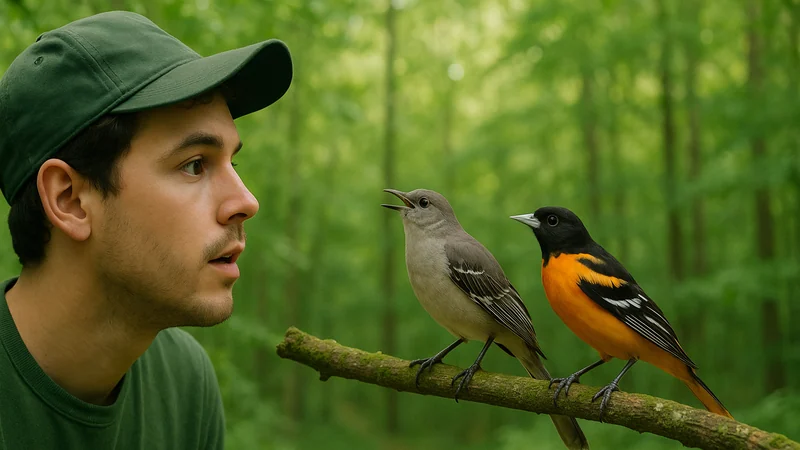
Some birds borrow other birds' voices, and a few will even throw in a car alarm or a squeaky gate for good measure. Northern Mockingbirds, Brown Thrashers, Gray Catbirds, European Starlings, and Blue Jays are the backyard voices that trip up beginners most, and Bird Call Identifier is a useful second opinion when a clip needs confirming. This guide walks you through those common lookalike-sounders in North American backyards and gives you the specific clues that separate them in the field.
Why the confusion is normal
Why this is easy to misidentify
Bird sound is not a signature the way a fingerprint is. Many species share short, high whistles or dry chip notes because the physics of a small syrinx pushed through leaves favors similar shapes. On top of that, a handful of species are true vocal mimics that deliberately learn other birds' songs. Northern Mockingbirds, European Starlings, Blue Jays, Gray Catbirds, and Brown Thrashers all copy sounds around them, each in a slightly different way.
Two more forces make it harder. Distance flattens tone, so a distant Blue Jay screaming like a Red-shouldered Hawk sounds every bit as raspy as the real thing until you notice the delivery. Season shifts the cast list because migrants pass through and briefly overlap with residents who share their pitch range. If you have ever thought a robin was singing from a tree that turned out to hold a Scarlet Tanager, you already know the feeling.
The good news is that mimics and near-mimics almost always give themselves away with a few structural clues. You do not need perfect pitch. You need a small mental checklist you can run in about ten seconds.
The tell-tale clues
The clues that separate close matches
Four questions do most of the work. Ask them in order, and the field of suspects usually shrinks to one or two suspects.
- How long does one phrase last, and does it repeat? A Northern Mockingbird typically repeats each borrowed phrase three or more times before switching. A Brown Thrasher usually repeats it twice. A Gray Catbird almost never repeats and rambles on in single phrases. That single rule sorts most mimic confusion.
- Is there a mew, a squeak, or a mechanical sound mixed in? Catbirds slip in their namesake cat-like mew. Starlings add wheezes, whistles, and impressions of killdeer, meadowlarks, and even the odd car alarm. Blue Jays throw in a clean rusty-hinge squeal that few other backyard birds make.
- Where is the bird singing from? Mockingbirds prefer exposed high perches: rooftops, wires, the tip of a shrub. Thrashers sing from the top of a dense thicket. Catbirds sing from inside the thicket. Starlings sing from a gutter, a chimney cap, or a dead branch, usually with wings quivering.
- What is the overall texture? Musical and confident, with clear pauses between repeated phrases, points to mockingbird or thrasher. Wheezy, rattly, and stuffed with clicks points to starling. Loose, unpolished, and jazzy points to catbird.
Run those four questions, and the mimic almost always identifies itself before the identification app even loads. For the broader set of everyday songs that trip up beginners, a look at the backyard songs most often mistaken for each other is a helpful next step.
Side-by-side
A side-by-side field comparison
These are field heuristics drawn from common birding practice, not accuracy claims. Keep this compact table in your head or on your phone while you are outside.
| Bird you are hearing | Often confused with | Sound tell | Visual tell | Where it sings | Season peak |
|---|---|---|---|---|---|
| Northern Mockingbird | Brown Thrasher, Catbird, robins, other songbirds it copies | Each phrase typically repeats three or more times, endless variety | Slim gray bird, white wing patches flash in flight | Exposed high perch, rooftops, wires | Late spring through summer, sometimes moonlit nights |
| Brown Thrasher | Mockingbird, Wood Thrush | Phrases usually repeated in pairs, richer and lower | Rusty-brown back, streaked breast, long tail | Top of a hedgerow or thicket | Early spring dawn chorus |
| Gray Catbird | Mockingbird, thrasher, distant hawk | Nonstop rambling, little phrase repetition, cat-like mew | Slate gray, black cap, rusty undertail | Inside a dense shrub, rarely exposed | Late spring through late summer |
| European Starling | Meadowlark, Killdeer, phone ringtones, other whistles | Wheezes and clicks between whistled impressions, wings quiver | Chunky black bird with spangled tips, yellow bill during breeding season | Rooftop, gutter, wire, dead branch | Year-round in most towns |
| Blue Jay | Red-shouldered Hawk | Two or three flat screams, then silence | Blue, white, and black bird with an obvious crest | Oak canopy, feeder edge | Year-round, most vocal in fall |
| Scarlet Tanager | American Robin with a sore throat | Robin-like phrases but burry, hoarser, and slower | Male brilliant red with black wings, hidden high in oaks | Upper canopy of mature deciduous forest | Late spring and summer in the East |
| Rose-breasted Grosbeak | American Robin, but sweeter | Robin cadence, purer and more musical, ends on a clear rise | Male black and white with a red bib, big pale bill | Mid-canopy of deciduous woods | Migration and summer breeding |
The single most useful column is repetition pattern, because it separates the three big mimics faster than any other clue.
Seasonal shifts
When season or setting changes the answer
The same sound in April and October often comes from different birds. Timing and habitat are the fastest filters you have. If you want to sharpen this by region, a regional field guide with call and sighting lines aligns the same clues with what is actually singing in your area.
Spring dawn chorus
In late March and April in the eastern United States, a loud, musical, repeated-phrase singer atop a shrub before sunrise is often a Brown Thrasher rather than a mockingbird. Thrashers peak early. Mockingbirds ramp up later and sing longer into summer, including on warm, moonlit nights.
Summer suburbia
By June, the persistent singer on a rooftop or a streetlight is usually a mockingbird. If a similar-sounding voice is coming from inside a lilac or a viburnum and you cannot see the bird, you are almost certainly listening to a catbird.
Fall and winter
Starlings dominate the mimic slot during the colder months. A metallic whistle from a supermarket parking lot in November is often a starling mimicking something it heard in spring. A Blue Jay imitating a Red-shouldered Hawk is also common in autumn, often near acorn caches.
Habitat as a shortcut
Deep woods change the answer. A robin-like song from high in an oak forest in June is more likely to be a Scarlet Tanager or a Rose-breasted Grosbeak than an actual robin, because robins tend to sing from lawns and low trees rather than from the canopy of a mature forest.
Working with the app
How Bird Call Identifier supports confirmation
Sound recognition is best used to narrow possibilities and confirm a hunch, and it is honest to say that no acoustic tool nails every mimic every time. Mimics are exactly where the record-a-clip and save-the-sighting habit pays off, because your later notes are what prevent a repeat mistake next spring.
A quick recording workflow
- Record a short, clean segment when the bird is singing steadily rather than pausing. Aim your phone toward the bird and away from wind.
- Listen for the repetition pattern yourself, then weigh the app's suggestions against it. Phrases repeating three or more times point strongly toward a mockingbird, whichever species the app leans on first.
- Cross-check with a visual clue. A Red-shouldered Hawk suggestion from a wooded backyard with a blue-and-white bird on the branch is a Blue Jay imitation.
- Note what you heard alongside the perch, behavior, and habitat you observed. Those details are what separate future you from making the same call twice.
Visual confirmation is still worth waiting for whenever the bird is in view.
Take it outside
Carry this into the field
One mnemonic covers most backyard mimic confusion: Three, Two, None, Wheeze, Scream. Three-plus repeats are typically mockingbird, two repeats are usually thrasher, no repetition is usually catbird, wheezy and mechanical is starling, and two flat screams from a wooded yard are Blue Jay pretending to be a hawk.
Before your next dawn walk or backyard coffee, keep a way to record within reach. A puzzling clip is much easier to sort later when you have the sound, the setting, and the time it was heard.